


The Lost Girls and Boys
Children are growing up too quickly, and then not growing up at all

Coddled Youth?
For a while now, people have been sounding the alarm that young people, like the titular hero in J.M. Barrie’s Peter Pan, do not seem to be growing up. Younger generations are described as “coddled”, stunted, “spoiled”, fragile, unprepared for the workplace, unwilling to learn how to drive, obsessed with children’s movies and toys well beyond childhood, addicted to social media, mentally ill and obsessed with psychiatric diagnoses, less likely to date and marry, less likely to want or have children.
“Childhood has lengthened, with teens treated more like children, less independent and more protected by parents than they once were. The entire developmental trajectory, from childhood to adolescence to adulthood, has slowed. Adolescence—the time when teens begin to do things adults do—now happens later. Thirteen-year-olds—and even 18-year-olds—are less likely to act like adults and spend their time like adults. They are more likely, instead, to act like children—not by being immature, necessarily, but by postponing the usual activities of adults.”
— Jean M. Twenge, iGen: Why Today’s Super-Connected Kids Are Growing Up Less Rebellious, More Tolerant, Less Happy—and Completely Unprepared for Adulthood—and What That Means for the Rest of Us (2017), page 41
I read
’s Bad Therapy: Why The Kids Aren’t Growing Up (2024) shortly after it came out (see my review here). I also read ’s and ’s The Coddling of the American Mind (2018) a few years ago; Haidt’s The Anxious Generation (2024) is on my to-read list, waiting for me in my Audible account. I’ve followed ’s research for about a decade, with both a lot of interest and frustration.I think these authors, and similar critics, have some good points and observations, however, as
points out in her 2022 essay, “Fragile students just need a hug”, the demand for “coddling” observed by Haidt and Lukianoff and reliance on “affirming” therapists described by Shrier appear to be symptoms of a greater issue.“[T]he “meltdowns”, the emotional dysregulation and demands for safety — all the behavioural tics characteristic of militant wokeism — map startlingly closely onto common symptoms of pre-verbal trauma. That is, they’re consistent with symptoms displayed by children abused or neglected before they learned to talk.”
In other words, the underlying issue isn’t that young American (and, more broadly, Western) minds are being coddled; it’s that they were neglected, in particular in the first few years of life. This, Harrington claims, is largely because more mothers work full-time than in previous generations and their children are sent to daycare; in the United States, due to lack of maternity leave, “one in four American mothers is back at work within two weeks.”
Childhood emotional neglect is defined as “a form of maltreatment in which caregivers fail to provide the emotional and psychological support, validation, and attention children need during their formative years.”
Jean Twenge was wrong when she claimed that “[t]he entire developmental trajectory, from childhood to adolescence to adulthood, has slowed.” Adolescence to adulthood has certainly slowed—and some might argue halted in many cases—but the trajectory from childhood to adolescence hasn’t slowed at all; it’s been sped up.
Children are growing up too quickly, and then not growing up at all.
Kids Are Going Through Puberty Too Early
A few weeks ago, an article by
called “Age of puberty in girls: Why it is declining and why that matters” crossed my Substack feed. Her post was in response to one by (“Girls are going through puberty too early”).Bismarck points out that the age of puberty in girls has been dramatically declining for decades, from between 14-17 on average in the 1800s (depending on the country), to around 12-13 today.1 Daughters, on average, are getting their periods around 1.5 years earlier than their mothers.
Bismarck suggests that this phenomenon causes “enormous trauma on a civilizational scale”, “is mostly responsible for the fear and contempt modern women increasingly have for male sexuality”, and may be “the primary cause of the massively inflated rates of transgender identification among adolescent girls.”2
He ends his essay with a plea to female Substackers to write about this topic, pointing out—correctly, I think—that this should be one of the “most important feminist issue[s] of our time.”
In her response, Sai expands on the topic and goes into detail about possible causes.
“[W]e might be in the middle of an unprecedented level of widespread endocrine dysfunction worldwide.”
She discusses factors such as endocrine-disrupting chemicals (EDCs), nutritional deficiencies (especially of Vitamin D and magnesium), increased consumption of processed foods and refined sugars, and chronic conditions associated with decreased gut microbiome diversity.
Sai also highlights father absence as being “one of the most prominent environmental factors in age of puberty,” arguing that “lower paternal investment might be working as a signal to trigger a faster LH [“Life History”] strategy in adolescent girls and therefore causing the age of menarche to decline.”
There’s also some evidence that a disrupted attachment to mothers is associated with earlier puberty in girls, whereas higher mother-daughter affection is protective.
The age of puberty onset has also been decreasing, to a lesser extent, in boys. In addition, the age of puberty onset differs dramatically between races (at least in the United States), with Black girls undergoing it up to a year earlier than white girls (and Hispanic girls undergoing it slightly earlier than white girls, and Asian girls slightly later).
Black and Hispanic girls are more likely to grow up in lower-income households and thus more likely to be exposed to environmental toxins and poorer nutrition than their white and Asian counterparts, and Black children are significantly more likely to grow up in single-parent (in particular single-mother) households. Asian children are the most likely to grow up in two-parent homes, and Asians are more likely to live in multigenerational homes than white people. Anecdotally, from my observation, Asian families also, on average, eat healthier than white families (this applies across income lines; my husband has observed that, growing up, his friends from lower-income Asian families ate healthier than his friends from affluent white families).
One of the major potential environmental factors, not discussed by Sai, is fluoride. Sai notes that the first major drop in age of puberty onset in girls occurred in the 1950s. This is right around the time that fluoride toothpaste became popular and fluoride was added to drinking water across North America. Fluoride has been shown in studies to accumulate in the pineal gland, which can disrupt production of the hormone melatonin, adversely affecting sleep and speeding up the onset of puberty (at least in girls). In one study, Jennifer Luke found that animals exposed to fluoride showed signs of earlier puberty.
Earlier puberty is linked to higher rates of mental illness, substance abuse, autism spectrum disorder, and ADHD.
My Experience
“Girlhood ends when the world looks at you.”
—
, “A Partial Explanation of Zoomer Girl Derangement”
The first time a boy showed interest in me, I was in grade five and had just turned eleven years old. He was about a year and a half older than me, and in grade seven.
I did not handle it well.
I got my first period a few months before my twelfth birthday, about eight or so months earlier than was average at the time. My breasts were already emerging. I went through a stage where I wore a lot of baggy clothes. Around this time, I developed a mild eating disorder, which, fortunately, I gave up by the end of grade eight. Around ages 10-12, I went through a stage of wishing I were a boy, which was partially influenced by the fact that the cousins and family friends around my age were all male and by one of my close friends in elementary school, a very gender nonconforming kid who would, in adulthood, transition to become a man.3
Boys commented on my breasts, awkwardly flirted with me, and tried to walk home with me. In grade eight I overheard two grade ten boys refer to me as the “hot grade eight” and I wanted to disappear into the sidewalk. In grade nine, at a pool party, a female friend once instructed me to put on my swimsuit and join the other girls in the pool because this would convince the boys at the party to come swimming. The boys did come out shortly afterward, and one of them undid my bikini top. I was fourteen, and already a C cup. I was in my twenties before I stopped contemplating a breast reduction.

My mother was fairly health-conscious and from my perspective did a better job of providing my brother and I with healthy food (and limiting junk) than many other parents, aided by a good budget for grocery shopping and her Southern Italian heritage. She also breastfed both of us for a little longer than average, around nine months, stopping both times because of sports injuries. However, she fell for many of the major food scams of the era, including the war on fat, pro-seed oils propaganda, and using margarine instead of butter, and while she modelled and encouraged minimal use of make-up and skincare products, she still slathered hormone-disrupting sunscreen on us on hot summer days and purchased shampoos and conditioners with phthalates and other EDCs. All in all, I probably had a slightly healthier diet and less EDC exposure than your average Canadian kid.4
Father absence and disrupted attachment were likely the bigger factors for me; my father worked long hours (80+ per week) and travelled frequently, often for stretches of several weeks at a time. Hours after my brother was born, he drove my mom home from the hospital, then left her there alone to go straight to work; he also went to work the day his father died, even though it was a statutory holiday. When my father was home, he was stressed and quick to anger; my mother, brother, and I walked on eggshells around him.
I spent a lot of time alone as a child, especially in the early years, and consequently had a very active imagination. This was particularly true when I stayed with my maternal grandparents, something I did frequently starting shortly after my mother weaned me at nine months. When I was a year old, shortly after surviving a one-storey fall onto my head and having to restart several developmental milestones, my parents went on a two or three-week vacation (depends on which parent I ask) and left me with my grandparents. My grandfather was loving and attentive, but worked most of the day; my grandmother was loving, but did not play with me or hug me and mostly left me to entertain myself.
While I obviously can’t recall how attached I was to my parents before the accident and their vacation, I do know that I had an avoidant attachment style afterward. I was odd and somewhat aware of it.5 I over-identified with the Disney character Dumbo so much I insisted my preschool teachers sign my artwork with Dumbo.

I was parentified and forced to grow up quickly in many ways. I was sleep-trained (the Ferber Method), and not welcome in my parents’ or grandparents’ bedrooms or beds. When I woke up sick at night as a child I’d go to the bathroom to throw up by myself; if my parents heard me, they’d remind me to close the door next time. I was frequently praised for being “easy” to take care of, and mature beyond my years. When I was sixteen and taking a course to become a swim instructor, the course instructor commented that I was awkward around kids and seemed like someone who “never was a child.”
The combination of a poor relationship with my father, growing up in a household with an unhappy marriage, and being ill-prepared for the male attention I began getting around age 11 all contributed to a negative attitude about men throughout my teens and twenties. I was frequently bitchy to boys and men who approached me—some deserved it (looking at you, ass-grabbers!), but most probably didn’t.
I made some unfortunate relationship choices. Others were probably just fine, but I had commitment issues and sucked at talking to guys about things they were doing that bothered me. I was a serial monogamist, often jumping into a new relationship within weeks of breaking up with the last guy. I continued to harbour a lot of resentment to men, stoked by the feminist-literary circles I was involved in in my twenties.
In my late twenties and early thirties, in part because of chronic health problems triggered by antibiotics, I regressed. I’d always been “old” for my age, and suddenly I felt much, much younger than I was. I backslid into a kind of second adolescence. I had been relatively well-behaved during the first one, but this time around I was angrier and more volatile. I had been doing okay, doing pretty well—at least superficially, at least from the outside, at least according to my parents—my whole life and I was tired of being okay, of being “good.” I was tired of trying to make other people happy. I fell into the psychosomatic hell spiral, and I couldn’t pull myself out.
Then, a miracle occurred: I met my husband when I was thirty-two, in the spring of 2020, in the wake of leaving an abusive relationship. We had a psychedelics-fuelled lockdown romance—which pulled us both out of our respective hell spirals, healed a lot of trauma and immaturity, and got us to quit processed foods, refined sugars, and alcohol—and by the end of 2020, we were married and I was pregnant. Now it’s four years later, we’re still very happy, he’s a wonderful husband and father, and we’re expecting our second child soon.
I’m very lucky.
But I’ll admit I found the couple of years of motherhood difficult; my husband and I were successfully giving our daughter a better childhood than either of us had had, and I found myself grappling with one of the ugliest emotions—jealousy. I wanted to be the child sleeping in her loving parents’ bed, being cuddled at night. Who adored her daddy and wasn’t scared of him. I hadn’t gotten the childhood I wanted or needed and now I coveted hers. I didn’t want to be the mommy, I wanted to be the baby.
I suspect I am far from the only parent to be affected by this particularly dark form of Peter Pan Syndrome.
I got over it. My husband was helpful, and I worked through it at plant medicine ceremonies and through conversations with my own parents. I was willing to face my demons and grow up if it meant I could heal and become a “good enough” mother.
“Why can’t you fly now, mother?”
“Because I am grown up, dearest. When people grow up they forget the way.”
“Why do they forget the way?”
“because they are no longer gay and innocent and heartless. It is only the gay and innocent and heartless who can fly.”
— J.M. Barrie, Peter Pan (1904)
Dissociating to Neverland While We Look The Other Way
I read Peter Pan when I was a preteen, while sick in bed with a flu. A detail in the backstory of the “lost boys” always stuck out to me.
“They are the children who fall out of their perambulators when the nurse is looking the other way.”
Peter Pan was published in 1904, around fifty years after the invention of the first mass-produced stroller (the “perambulator”) by American inventor Charles Burton (other sources claim that prams first appeared in the mid-1700s). “Prams” were originally a luxury item, but by the end of World War I, they were available to all but the poorest families, and by the 1950s, they were considered a “must-have” for any new-parents.
Prior to this, Western babies were carried in slings, baskets, and packs—and this is still the case for the majority of children outside the West today.
Last month, in a post wondering “Are Millions “on the Spectrum” Now?”,
observed:“I saw lots of affluent younger moms pull a plastic covering, like a clear Zip-Lock bag designed for baby humans, right over the toddlers in their strollers — rain or shine — and, as if the moms have closed up a business venue for the day, they’ll then wedge their phones against the push-bars of the stroller and walk the stroller, with their eyes glued to the screens.”
This is an extreme example. Most of the parents and nannies I observed on the long walks I took with my daughter, strapped in a wrap to my chest, were not on their phones (Wolf is in New York, I’m in Vancouver, and I imagine that would make a difference). But most were in strollers, and covered in some way. And it’s striking how much more my daughter got out of walks merely because she was strapped to my chest, her face near mine. She was more of a participant when I started conversations with other caregivers or chatted with my husband or a friend, she looked around at the world more, she put her hands on my face and demanded my attention. Strangers were more likely to come up and say “hi” to her. And she still got some great naps, pressed firmly against my body, her ear to my chest, listening to my heart.
The first “smartphone” was introduced in 1994, and the first iPhone in 2007. While researchers such as Jean Twenge and Jon Haidt have done a good job of discussing how smartphone use has negatively impacted children and teenagers’ mental health, they oddly—to my knowledge—do not discuss how smartphone use by parents might be playing a role: from 2006 to 2009, the number of 30-49-year-olds who were on social networks rose from 6% to 44%.
“I see many children on the streets of New York in their strollers, facing away from their mothers or nannies who are on their cell phones or who look disengaged themselves; they are anything but present. The babies have a glazed look in their eyes, which is the result of feeling disconnected from the person who is central to their secure attachment. This kind of emotional withdrawal is the basis for depression in older children, adolescents, and adults. In my consulting room I see the same look in the eyes of my adult patients who have experienced absent mothers.”
— Erica Komisar, Being There: Why Prioritizing Motherhood in the First Three Years Matters (2017), page 156
The “freeze” response to trauma is the dissociation response, which includes escaping into fantasy through books, TV, video games, and daydreams. Childhood emotional neglect—which includes being ignored by your primary caregiver(s)—is a significant trauma.
Maladaptive daydreaming describes the persistent escape into fantasy worlds to the point that it disrupts one’s ability to live in the real one—often, the lines blur between fantasy and reality. It may, according to one study, “have a compensatory role in regulating unmet personal needs.” (E.g. participants with separation anxiety were more likely to report fantasies of idealized relationships, and grandiose participants were more likely to report fantasies of power and dominance).
An escape into one’s personal Neverlands.
Maladaptive daydreaming is highly correlated with a diagnosis of autism spectrum disorder, and with vulnerable narcissism, borderline personality disorder, schizoid personality disorder, and anxiety, depression, ADHD, and OCD. It is associated with spending a lot of time alone as a child, and known to be common in children who were neglected or experienced abuse.
I read too many books as a child, and I was a maladaptive daydreamer.
The Dark History of Western Parenting
The decline in the age of puberty onset started around the Industrial Revolution (1760-1840), in alignment with urbanization and development. Higher exposure to EDCs would explain some of this effect—as would increased processed food, refined sugar, and and refined flour intake6—but it doesn’t explain all of it.
In one of my first posts on this Substack, I detailed the dark history of parenting books which became popular starting shortly after the invention of the printing press, in particular from the 1700s onward. The “poisonous pedagogies” in these books led to a rise in parenting behaviours that can be considered emotionally negligent or even abusive, in particular among affluent and social-climbing Western and Northern Europeans and their descendants in the colonies.
For example, Dr. Moritz Schreber (1808-1861), author of multiple best-selling parenting books in the 1800s, is credited with being largely responsible for multiple generations of German children growing up “without direct, loving contact with their parents” and other family members. He had three children who were later diagnosed with mental illnesses, including one who committed suicide.
Other examples include Dr. Luther Emmett Holt, who introduced the “cry it out” method of sleep-training in 1894 (still recommended in a majority of parenting books), and John Watson (1878-1958), the “father of behaviorism”, who instructed parents not to excessively hug, kiss, or coddle their children. Watson’s granddaughter, actress and comedian Mariette Hartley, later wrote a book, Breaking the Silence (1990), criticizing her grandfather and describing a family legacy of abuse, suicide, and alcoholism.
This era was also one of increased mobility, and thus saw more parents raising children away from extended family. The disruption of family attachments caused by mobility and poisonous pedagogical ideas about parenting likely played a significant role in the decrease in age of puberty onset that began with the Industrial Revolution.
The 1800s was also the era when it became more common for young children to sleep apart from their parents. By the 1970s, this practice had expanded to putting each child in their own bedroom. In the mid-1800s, baby formula was invented,7 and by the 1970s, only around 10% of American mothers breastfed their babies past four months; breastfeeding has made a comeback, fortunately, but still less than half of mothers exclusively breastfeed until their children are six months old (even the WHO recommends breastfeeding for two years).
Western children also have unusually early bedtimes and are less included in parents’ social lives because of it.
We were at a small party a few weeks ago. My daughter came with us, and another couple brought their baby. Both girls had a lot of fun and got a lot of attention. A father was also there; while watching our daughter run around he mentioned his wife and toddler hadn’t come because his daughter had a strict 7:30pm bedtime. He also complained (mildly) about his child waking him and his wife up as early as 5am some mornings.
He defended this routine, in the way that one does when something is not really working. He wished his wife and child were with him. He resented being woken up early.
I didn’t say anything, but I imagined this from the child’s point of view. You wake up and your parents are annoyed and exhausted. Then you are forced to go to bed hours before they do. From the child’s perspective, the parents don’t want to spend time with her. This clearly wasn’t the case; this father loved his child and clearly wished she were there at the party. But the strict early bedtime, which had been drilled into him and his wife as necessary, as the “correct” way to parent, carries the risk of creating this misunderstanding.
My family goes to bed together around 9:30pm every night, bumping this to 10:30-11pm on nights like this one, where we go out together. By the time my daughter wakes up, I’ve been up for at least an hour, eaten something, and had some coffee. I’m awake and ready for her. I don’t have to miss parties because of her bedtime. Yes, the privilege I have as a stay-at-home mother makes this easier; but I know couples who put their toddlers to bed around 8:30pm-9pm, and all wake up together around 7am, with enough time to get ready, do a daycare drop-off, and make it to work. This allows for some flexibility with socializing, especially on weekends.
“Settlers brought a European pattern of unnested care (e.g., isolation apart from the community, corporal punishment, unwelcoming community, nature disconnection). […] Babies were and still are coerced into schedules for eating and sleeping, and even spanked, “for their own good”. They spend a great deal of time physically isolated (not in arms) and if they cry it is considered “what babies do.” All these ideas and practices are contrary to humanity’s heritage, as documented by ethnographers.”
— Darcia F. Narvaez, “Putting Childraising Back on Track”, Psychology Today
Baby formula is now a 55 billion dollar industry,8 with soy formula having a market share of over 300 million USD. The crib and bassinet market is worth over 1.3 billion and the baby monitor industry is worth 1.6 billion.9 The baby stroller market is worth over 4.5 billion, with high-end strollers costing over $1,000.
The traditional ways—still common in many countries today—of bed-sharing and breastfeeding are free (except for mom’s extra calories). The wrap my husband and I used instead of a stroller cost less than $50.
Early emotional neglect—i.e. lack of coddling in the infant and toddler years when coddling would be developmentally appropriate—leads to traits such as validating-seeking, hypersensitivity, poor boundaries, anger issues and outbursts, and susceptibility to groupthink (as described by Harrington), as well as to an obsession with power, overachievement, perfectionism, codependency, tendency toward exploitative relationships, impaired ability to form authentic attachments, and an obsession with language and bureaucracy.
All of the traits I just mentioned are described in the various works by Alice Miller (1923-2010) about “poisonous pedagogies” and their impact; she also argued that these toxic ideas about childrearing resulted in psychologically distressed and alienated children with a vulnerability to narcissism and totalitarianism, and played a significant role in the rise of Nazi Germany.
It also makes sense, that this would speed up development—both pubertal and otherwise—in the early years (indeed, books about neglected children and children of narcissists frequently describe children who are “mature” for their age).
Americans alone spent an estimated 31 billion dollars on child mental health services in 2021. The annual economic cost of mental illness in the US is estimated at 282 billion USD, and in Canada at 50 billion CAD.
Working Women, Unnested Children?
“In an effort to guard women’s rights, children’s rights were thrown under the bus.”
— Erica Komisar, “Motherhood, Feminism and Child Outcomes”, YouTube
I’m not going to spend a lot of time on this one, because both survey data and my own anecdotal experience indicate that the majority of mothers of young children want to be stay-at-home parents or only work part-time; and most of those who do wish to return to full-time work wish they could take longer maternity leaves.
The issue is that they cannot afford to.
Western governments want mothers in the workforce, whether mothers want to be there or not.
A few considerations:
Prenatal stress in mothers has been linked to earlier adrenal puberty in first-born daughters (working full-time while pregnant can contribute to stress).
Mothers who have to return to work are more likely to stop breastfeeding (or not breastfeed at all). Multiple studies have found that breastfeeding is protective against early puberty. In the United States, around one quarter of women return to work within two weeks of giving birth.
Parents who are stressed out and busy have less time and energy to prepare healthy meals and are more likely to rely on processed convenience foods; this is particularly true if the child is in daycare and lunches and snacks are packed. As previously discussed, diets high in processed foods and low in nutrients are linked to earlier puberty.
I was unable to find any studies that looked for a link between going through puberty early and earlier use of daycare. However, a link between early, extensive hours in daycare and poor behavioural and mental health outcomes has been established in a handful of studies; as well, a link between early daycare and obesity has been found.
“[W]hen we abandon “mother” as a default term in the interests of inclusivity, (in favor of “attachment figure” or “primary caregiver,”) it may erode our sense of babyhood — a time when immutable, primate, mammalian needs must be satisfied.”
—
, “Universal Early Childhood Daycare Has Been Proven to Damage the Children Who Have Been Through It” (emphasis mine)
My intention is not to blame or shame individual parents, nor daycare workers, who typically are doing their best under difficult work conditions. I am also not arguing against the inclusion of women in the workplace or mothers with careers. I think in an ideal world, if we wanted to support working mothers and produce healthier children, paid (EI) maternity leave—at a minimum—would start at the beginning of the third trimester and continue until the child turns two, with an option to take a third year unpaid and still be able to return to your job. Professions that are female-dominated (e.g. nursing, teaching) should have more part-time positions and job-share options available. As well, grandparents and fathers can also fill the primary caregiver role and do a great job.
However, public feminists would do well to realize that the majority of women do not have rewarding, high-powered, and stimulating jobs. Most women—most people in general—have jobs that kind of suck.10 This is true even of jobs that seem appealing, or which perhaps were more rewarding 30-40 years ago.
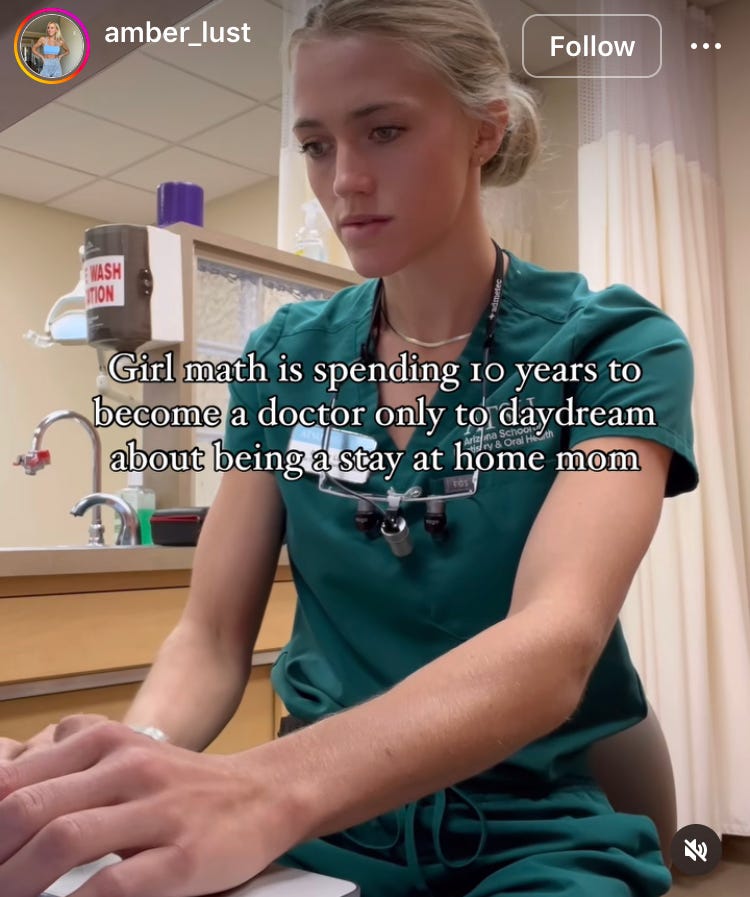
The push for gender parity in workplaces and high-status careers is not compatible with (most) mothers’ desire to stay home with their children. This is an unrealistic, unhealthy goal and the damages from the lie that this is desirable are manifold.
The Meritocracy Trap and the Price of Privilege
The growing gap between the very highest paying jobs/careers and pretty much everyone else, the consolidation of wealth and power into fewer and fewer hands (e.g. the decline in small businesses), the push to have every capable adult in the workforce (etc) all contribute to a culture of high competition, even—or perhaps especially—among people at the very top rungs.
In his 2019 book, The Meritocracy Trap, Yale professor Daniel Markovits argued that this was the case; that the highest-paying jobs now require the most insane work hours and affluent children are now forced to earn their status (it has become fairly common for rich parents to announce that they won’t leave their wealth to their children because they should “have to work”)11 through an increasingly intense meritocratic competition, beginning as early as toddlerhood with a rat race for elite preschool and elementary school spots.12
This is reflected in Lukianoff and Haidt’s observations that lack of free play in childhood may be contributing to the mental health crisis on campus (The Coddling of the American Mind, Chapter 9: “The Decline of Play”) and the following excerpt by Abigail Shrier in Bad Therapy (pages 236-237):
“If you are a teenager today […] Your parents obviously prefer you to get your direction from the adults they’ve hired, who report to them. Each day is activity-jammed, presided over by a series of adults who judge your progress[…] You are always, in everything you do, monitored by anxious adults. You get less sleep than any previous generation of teens—far less than you need. You are so tired some days, it feels as though you are missing a layer of skin.”
Research has found that affluent children have similar rates of mental illness and addiction as poor children, with explanations for this including parental absence and distraction, and, at least in the case of upper-middle-class and affluent children, of a crushing pressure to achieve.
“It is hard to develop an authentic sense of self when there is constant pressure to adopt a socially facile, highly competitive, performance-oriented, unblemished “self” that is promoted by omnipresent adults. This many encourage some children to perform at high levels, but, more important, it also encourages dependency, depression, and a truncated sense of self in most children. Parents pressure their children to be outstanding, while neglecting the very process by which outstanding children are formed.”
— Madeline Levine, The Price of Privilege (2006), page 65
Walt Bizmarck argued—astutely—that the trauma of early puberty among girls is likely contributing to the recent increase in transgender identification among them (anecdotal examples here and here). Perhaps so, but I occasionally read the articles from distraught parents of transgender children in the PITT Substack. I’m struck by how many mention that their child is “gifted”, with some going as far as to mention their child’s specific score on an IQ test (examples here, here, here, and here). Notably, one essay describes a “fancy private school” in the US where of the students who had been identified as National Merit Semifinalists (tested in the 1% of Juniors who took the PSAT), 30% were trans-identified.
I discuss this at length in my essay “The Drama of the Gifted Children”, which examined the links between high functioning autism, mental illness, gender dysphoria, and childhood “giftedness” (often a product of a combination of parental cultivation and emotional neglect resulting in, loosely, a “left hemisphere” dominant way of perceiving and interacting with the world).
The Lost Boys of the Peter Pan story—who all hail from affluent families—are independent well before it is developmentally appropriate, and so they never grow up at all. Today, girls and women seem to be disproportionately negatively impacted by meritocratic competition and pressure to be high-achieving; in addition to the rising rates of transgender identities, I believe this is one of the reasons for the increasing rates of chronic illness, mental illness, and autism/ADHD among young women—in particular, it seems, young white women from upper middle-class or affluent backgrounds—and for their strong identification with these diagnostic labels.
I cannot emphasize this enough; the various factors I’ve discussed in this essay—early childhood stress, a push for early achievement, attachment issues, poor diet, hormonal disruption etc—all contribute to children being more likely to develop physical and mental illnesses, to be “neurodivergent”, and to experience gender dysphoria. I’m not claiming that anyone is lying about their experience. It’s more complicated than that.
What I am saying is that one of the reasons young people are identifying so strongly with their various labels is that it gives them an “out”, an escape to Neverland.
“June felt that she’d powered through school and excelled as a child but had burned out as a young teen. None of what she’d been so focused on made any sense to her anymore. While June had long appeared to everyone around her as a Meaning Type, floundering to step into the expectations of “adulting” and unable to leave home, her self-diagnosis was that this phase had come after a stretch in which she’d felt entirely functional. She’d just hit a wall. Something had broken.”
— Satya Doyle Byock, “I Don’t Want To Grow Up”
The final chapter of Suzanne O’Sullivan’s The Sleeping Beauties: And Other Stories of Mystery Illness (2021) provides another good example. A 20-year-old patient, “Sienna”, comes to see Dr. O’Sullivan with a litany of diagnoses, seeking a diagnosis of epilepsy (after another doctor rejected the diagnosis). Almost immediately upon entering her office, Sienna’s mother launches into a speech about how “talented” and “high achieving” her daughter was before the onset of illness. O’Sullivan quickly realizes that Sienna is suffering from a functional, psychosomatic illness—dissociative seizures.
“Sometimes when talking to people with functional disorders, it feels almost as if they want their suffering acknowledged more than they want treatment. A diagnostic label does that, but it has to be a good enough diagnosis.”
— Suzanne O’Sullivan, The Sleeping Beauties (2021), page 276
Eventually, after several tests prove O’Sullivan’s hypothesis correct, she caves to the pressure to give Sienna a diagnosis, and writes her a letter asking for accommodations (“a quiet environment” and “extensions”) for a difficult university course.
“If I had been more truthful with Sienna, I would have said I thought her symptoms indicated a difficulty coping with escalating academic pressures. I would have said they were not an illness, but a sign that the life she had chosen was impacting negatively on her. If she was struggling to achieve her goals, maybe they were the wrong goals. But, in Western society, when things are going badly for a person, medical explanations are often sought because they are found to be more palatable than psychosocial explanations.”
— Suzanne O’Sullivan, The Sleeping Beauties, page 291
At no point does O’Sullivan doubt that Sienna is suffering; she clearly is. But she isn’t suffering from physical illness, at least not in the conventional sense. She’s suffering from her parents expectations, and her own, of the crushing pressure to excel and be exceptional.
“It is when a parent’s love is experienced as conditional on achievement that children are at risk for serious emotional problems.”
— Madeline Levine, The Price of Privilege (2006), page 30
The “sick role” allows for the abdication of adult responsibility, an excuse not to grow up, a narrative from which one can ask for the coddling they were denied as small children.
The children are collapsing under psychosocial pressure, chronic loneliness, and straight-up poisoning by various chemicals and toxic “food” products in their environments. They’re forced to grow up quickly. And they do. But one of the consequences of speeding up early development can be emotional stunting; a seeking of the validation, “care”, and opportunities for play and identity experimentation that were suppressed in childhood.
This is a complicated issue, with no easy solutions (and as Western governments, mainstream media, and corporations all benefit from this, they’re unlikely to do anything to improve the situation).
For now, I just want more open conversation about these issues. I welcome your feedback and insights in the comments.
The Guardian reported in 2012 that the age of puberty onset for girls had fallen by five years since 1920. “[Researchers] found that in 1860, the average age of the onset of puberty in girls was 16.6 years. In 1920, it was 14.6; in 1950, 13.1; 1980, 12.5; and in 2010, it had dropped to 10.5. Similar sets of figures have been reported for boys, albeit with a delay of around a year.”
Also related to this,
wrote an interesting piece about how early exposure to pornography (in particular violent pornography and other violent sexual imagery) is traumatizing girls. Being a nerdy 90s kid, I avoided exposure to porn, but read several graphic rape scenes in fantasy novels while still in elementary school, which definitely screwed me up and made me more hostile towards boys and men. I also wonder if early exposure to sexual content might contribute to earlier puberty and kids growing up too quickly (not to the same extent that sexual abuse is known to, but in a similar way?)Not a case of “rapid onset gender dysphoria”, this friend presented as unusually masculine from toddlerhood and was always “one of the boys” more than “one of the girls.”
I also would have had less fluoride exposure than many kids; while my family used fluoride toothpaste, my city does not add fluoride to the tap water.
Generally, I seem to over-estimate my ability to pass as “neurotypical”. Apparently the spot where I hit my head is associated with anosognosia, or a “denial of deficits”, which is kind of hilarious. In elementary school, during one of the fun-facts-about-yourself sharing circles, I told the class about my head injury and the teacher looked at me curiously and said, “Oh, that explains a lot.”
Naomi Wolf also describes “Parents at the bodega [who] urge their kids to get Hershey’s bars or potato chips for breakfast”, noting that the trend seemed to be “widespread”, with “wealthy parents urging their small kids to choose cake pops or chocolate donuts for breakfast.” Abigail Shrier also describes “gentle” parents who cater to their children’s unhealthy food preferences in Bad Therapy: Why the Kids Aren’t Growing Up.
Prior to the invention of baby formula, many wealthy households employed “wet nurses” to feed their children. Wet nurses, typically poor women, were often forced to give up feeding their own children to take these jobs, often leading to their children being malnourished or dying. Before the abolition of slavery, female slaves were often forced to do this task, with wealthy women deliberately timing their pregnancies with those of their slaves. Around 20% of white slaveowners relied on their slaves to feed their children. So I’m not opposed to the existence of baby formula, which is can be lifesaving in some circumstances, and is preferable to the exploitation of the old days.
In pursuit of profits, baby formula companies have gone as far as to lobby against improved parental leave policies, thus making it harder for women to breastfeed their children.
Baby monitors which use WiFi are also horrifyingly easy for predators to hack. As well, it’s possible that WiFi baby monitors are dangerous for babies? (Question mark because I haven’t taken the time to really investigate or understand this argument, but the article I linked to has lots of sources cited). Oh, and a quick Google search turned up an article claiming that EMFs (electromagnetic fields), including from WiFi, might be contributing to early puberty too.
David Graeber’s argument in Bullshit Jobs (2018) is relevant; a significant percentage of the US workforce believe that their jobs are “bullshit” or have no real value, or that a significant amount of their time is wasted at work. In addition, many jobs are created to compensate for lack of free time (a relevant example here being the need for more paid care workers).
This also appears to lead to higher rates of anti-natalism. After spending pretty much all of their lives in intense academic and workplace competition to achieve a prestigious career, many women are reluctant to then give up or compromise their careers to invest in raising children (not to mention they often have student debt to pay off). In addition, many women don’t want to put their children through the same competitive misery they experienced (South Korea provides an extreme example).
I enjoyed this and I’m glad you tagged me. I agree deeply with almost all of it.
One of the frustrating things about having young children and only concurrently realising many of the truths you list is that it’s too late to avoid repeating some of these flawed methodologies, because you don’t have the necessary alternative social infrastructure in place.
We’re trying to improve child by child. Our next step is to get a reverse osmosis filter on our tap water, and glass bottles to store it in, etc.
Hopefully by the time grandkids are on the scene we’ll be in a position to have them set up for success on all fronts by day one.
"I’m not going to spend a lot of time on this one, because both survey data and my own anecdotal experience indicate that the majority of mothers of young children want to be stay-at-home parents or only work part-time; and most of those who do wish to return to full-time work wish they could take longer maternity leaves.
The issue is that they cannot afford to."
This came about in part because of a change in banking regulation that took place, IIRC, in 1974. Before then, a FDIC-insured bank (pretty much all of them) could take only one income into account in deciding whether to extend a home mortgage loan and on what terms. A second income was considered "temporary", as if the either spouse lost their job, the family's ability to service the loan was called into question.
After the change, the bank could take two incomes into account. The upshot of this change was that both spouses had to work to afford a home in a semi-decent exurban school district, because they were competing with two income families. (This is also one reason why the prices of residential housing soared in the 1970s, as there was more money became available to chase real estate.)
For those of us who are not feral cats or hedge fund billionaires, anything else was like showing up at a gunfight, armed with a Super Soaker.
This rather obscure change in regulation went almost unnoticed at the time. But it probably had more real world impact on the average frustrated American family than all the Supreme Court decisions ever handed down, all the presidential elections ever to take place, all the LGTBQXYZPDQ+ ever to draw breath.
We can argue later whether the change was a good thing or not. At this point, good luck getting that genie back into the bottle.