
Change Doesn't Happen Overnight: Psychedelics, Spirituality, and Getting Christmas Carolled
A review-discussion of "Spirited" starring Ryan Reynolds and Will Ferrell

Can people really change for the better? I want to believe we can — but it’s not easy.
Spirited, the 2022 Christmas Carol-style musical flop starring Will Ferrell and Ryan Reynold is finally having its moment this December, becoming a worldwide streaming hit. And I am here for it.
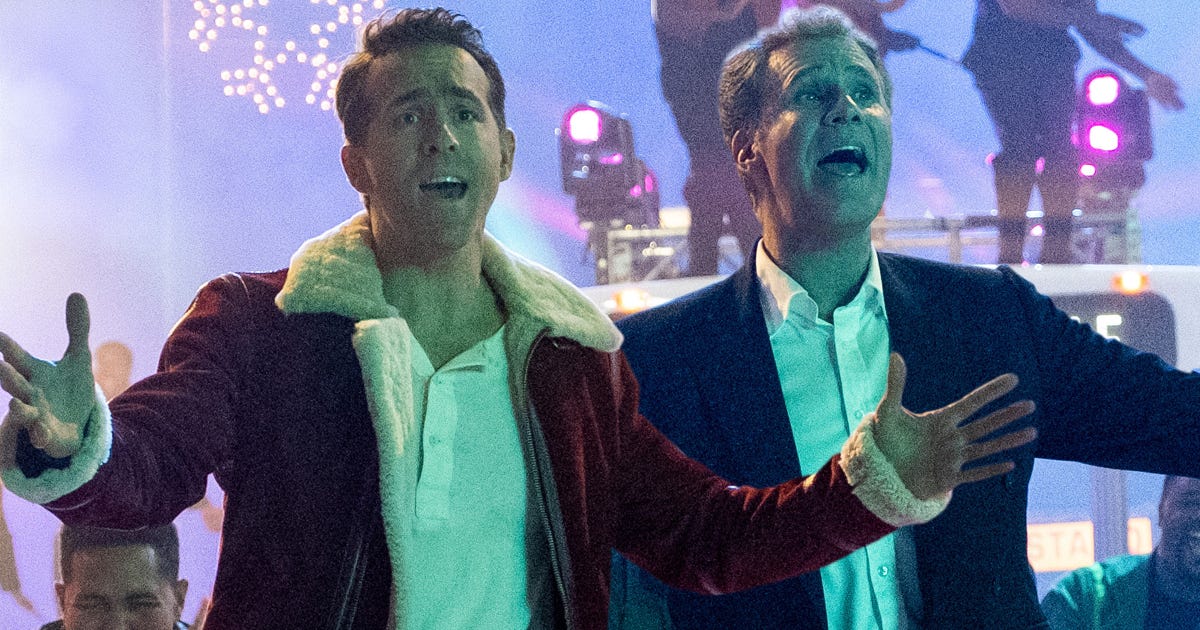
Spirited has everything I love in a musical: campy one-liners, over-the-top dance sequences, songs that go on a bit too long, a hopeful message about the healing power of love and human connection. I’ve lost track of how many times I’ve watched it (December only!) since it first came out; at this point even my one-year-old is attempting to sing along with the songs.
(Warning to parents, it’s not really a movie for little kids (it’s PG-13), I’m just enough of a Bad Mom to let some colourful language and sexy jokes slide in a fun flick with a good message, especially if it’s a musical).
The ghosts of Christmas Past (Sunita Mani), Present (Will Ferrell), and Yet-To-Come (Tracey Morgan!!) are back in a modern-day retelling of Dickens’ A Christmas Carol, and along with Jacob Marley and a team of Dead Sinners in the Afterlife they are trying to redeem an “unredeemable”, the most extreme case the team has had to deal with since Ebenezer Scrooge himself.
The “perp” in question is Clint (Ryan Reynolds), a fast-talking PR executive who has made himself rich and powerful by exploiting the worst aspects of the human psyche. His trip with the Spirits gets off to a rocky start after he pisses off Jacob Marley and seduces the Ghost of Christmas Past, leaving Christmas Present (Ferrell) to take over the haunt.
Clint is a tough nut to crack — he’s cynical, he sees the worst in people, and he ardently believes that people cannot change. Worst of all, he has an insanely high verbal IQ and talks circles around the Ghosts, eventually manipulating Christmas Present into revealing that he used to be Scrooge when he was alive, and that his obsession with “redeeming” Clint comes from an insecure belief that he never really changed himself; after all, Scrooge died only a few weeks after his own infamous haunt.
Like so many wounded healers, Present/Scrooge is motivated just as much by his own ego and desire for redemption as he is by changing his yearly “perp” for the better. Clint’s ability to rationalize his own behaviour and turn anything into a joke makes him immune to the whole “cosmic social worker” routine, but once he triggers Scrooge’s mask to slip, Clint’s redemption comes in an unexpected way as the two “unredeemable” men bond and become genuine “bros”.
Two sinners, after all, tend to have far more chemistry than a sinner and a saint.
Some spoilers follow, if you haven’t seen the movie and plan on it, I recommend going and watching it before returning to this essay. Put the subtitles on if that’s your thing and/or you have some trouble following lyrics on the first listen.
A Christmas Carol as a Metaphor for Magic Mushrooms
The original Christmas Carol story is a good metaphor for a high dose magic mushroom trip (over 5 grams, or a “hero’s dose”).
Hero dosing psilocybin mushrooms can involve an ego death — going through your past, present, and possible future(s) with the Spirits and seeing yourself in a more objective light. Some people get more of a It’s a Wonderful Life experience, others get Christmas Carol-ed.
Both experiences can lead to positive behaviour changes and better overall physical and mental health, but obviously getting Christmas Carol-ed is much more psychologically difficult. Without proper support, people who get the Christmas Carol experience are a significant risk for developing new or more serious mental health issues, and even suicide.
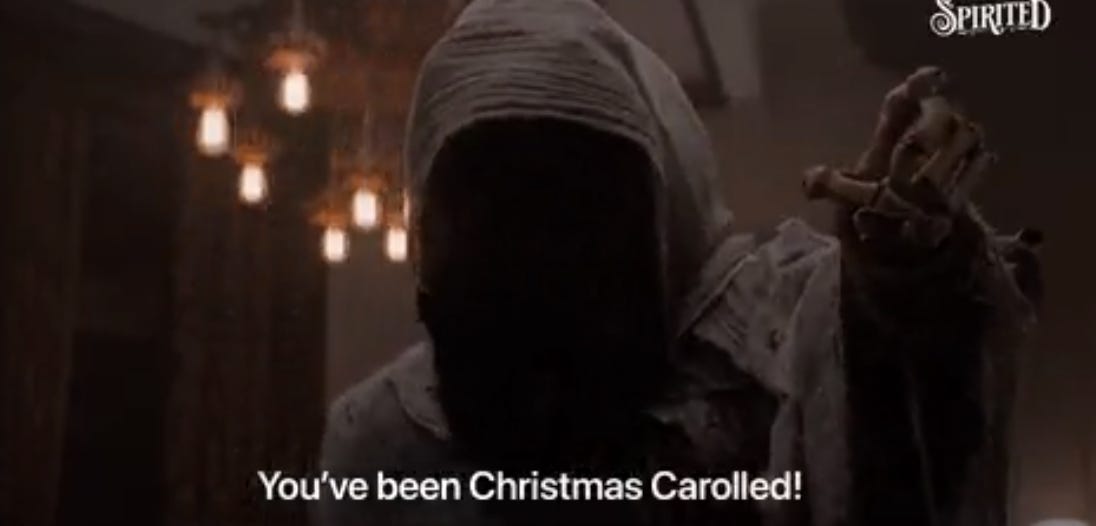
Spirited addresses one of my core qualms with the original Christmas Carol story. When Scrooge wakes up from his night with the Spirits, he goes out on Christmas Day and starts buying people gifts and food, donating to charities, and raising his employees’ salaries. Scrooge gets to take a shortcut to human connection and acceptance because he’s a super rich guy who is finally sharing the wealth.
Would anyone have cared about Scrooge’s change of heart if he’d also woken up broke?
Maybe. But it probably wouldn’t have gone as well for him.
Spirited also handles the whole “hurt people hurt people” thing far better than the source material. When we go into Clint’s past, we learn he was raised by an abusive, alcoholic single mother — however, unlike Scrooge, he also has a brother and a sister, and both of them are depicted as fundamentally kind, loving, and caring people. Not everyone raised in abusive, neglectful, and toxic homes turn out the same. A traumatic backstory is not an excuse to be an asshole as an adult.
Spirited gives us a more complicated redemption arc for Scrooge; he dies weeks after his psychedelic trip with the Spirits, having love-bombed and purchased his way into better relationships with his nephew and Bob Cratchit’s family, but there’s no evidence he has learned how to sustain meaningful and authentic relationships with other people. Notably, he is still unmarried and childless himself.
After his death, Scrooge immediately jumps into helping other people with visits from the Spirits, eventually taking on the role of Christmas Present. Similarly, one of the most common responses to extreme healing experiences on magic mushrooms or similar entheogenic medicines is to want to spread the gospel of psychedelics and to work with them to help others.
But Scrooge never actually had the opportunity to prove that he’d really changed. His nephew and Bob would be forgiven for thinking his generosity was just a manic episode before he kicked the bucket. Consequently, Scrooge becomes an unhealed would-be healer in his role as Christmas Present.
I’ve sat in plant medicine ceremonies with facilitators who seem somewhat unhealed themselves and compensate with an over-the-top guru performance which, frankly, isn’t the best energy to be around when you’re going through it yourself. Scrooge makes the same mistake; his performance as a Cosmic Social Worker is very forced and artificial.
Clint sees through the facade immediately and calls bullshit on the whole thing. “You’ve been at this, what? Two hundred years? Is mankind getting any mankind-er?”
Tellingly, there is no evidence that the “cosmic social workers” ever do any follow-up with their “perps” to see how they’re doing post-haunt, and whether they’ve been able to sustain the changes they promised the Spirits they’d make.
Psychedelics Versus Spirituality (and Love)
To be clear, high doses of psilocybin can trigger healing miracles, both physical and psychological. They can pull a person out of addiction and/or depression, repair cellular damage and restore youth, cure chronic migraines and cluster headaches, treat PTSD, and heal eating disorders and other gut disturbances — there’s even a case study out there where they restored a paralyzed man’s ability to walk.
But whether or not any of these changes stick depends on the lifestyle changes. I can glibly tell people that magic mushrooms “cured” my chronic migraines and healed gut issues and picky eating I’d struggled with since I was a kid, but the reality is that after my first couple of big doses, I quit drinking alcohol, I cut sugar and processed foods from my diet, and I started prioritizing spending time outside in the sun, with people I cared about (yes, this was in 2020, but I was a Lockdown Rebel from the get-go).
I also really lucked out and met my husband while I was getting into healing myself with mushrooms. I roped him into my psilocybin bender, which put him into recovery from a six-year opioid addiction and quite quickly Chad-ed him up.
Something uncomfortable I’ve learned is that the healing benefits of psychedelics are amplified if you are taking the medicine with someone you care about — especially when you’re having sex with them while high.
“The best results come when you fuck someone you really love, during the acid trip. That’s when the nervous system is most open, most unconditioned, and ready to take a completely new imprint.”
— Timothy Leary, quoted in Robert Anton Wilson’s Cosmic Trigger I (1977), page 33
Great. I mean, unfortunately, this was my experience and I suspect it’s true, but it’s also extremely unhelpful for most people. Doctors, therapists, plant medicine shamans and all other professional healers cannot prescribe or dose someone with the medicine that will probably help them the most — that is, love.
In Spirited, Scrooge/Present has been eligible for “retirement” for ages, but is too scared to return to Earth because he’s afraid he’ll fall back into his old selfish patterns.
This changes when he falls in love with Clint’s “stone cold killer” head of opposition research, Kimberly (Octavia Spencer). Scrooge/Present relates to Kimberly because she’s, in her own words, a “terrible person” — but she doesn’t want to be. Without spoiling too much, Scrooge/Present wins over Kimberly because he sees the good in her; he’s projecting on to her a version of herself she’d like to be, and who she eventually takes critical steps to become (no haunting required!).
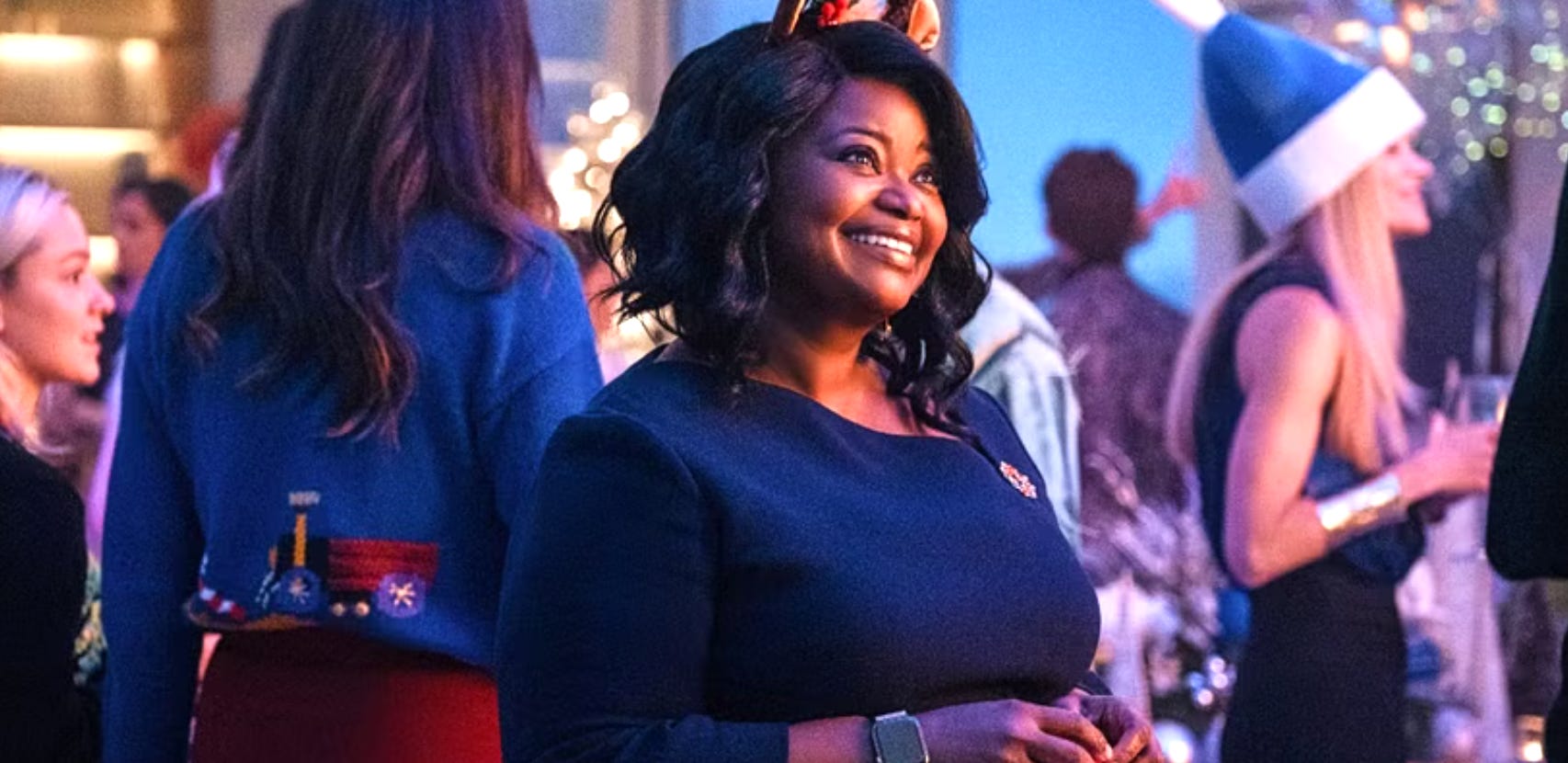
Kimberly starts to see the good in Scrooge/Present as well. At the end of the movie, Scrooge has returned to Earth, and has married and had children with Kimberly. Both are redeemed, both are changed, through their relationships to each other and their children. Similarly, Clint is not redeemed by his experiences with the “Spirits”, but rather by his genuine affection for and friendship with Scrooge.
Psychedelics can provide mystical experiences — they can show people themselves, God, the interconnectedness of nature and humanity, they can give you a taste of a powerful, healing cosmic love. Jesus might drop down from the sky to talk to you. But true spirituality, true love, cannot be achieved through psychedelic medicines; they can only provide a pseudo-”spiritual” experience which can drive a hunger for the real thing.
Spirituality, authentic connection to God and other people, is a daily practice, not something that people can achieve in one magical night. If you want to be a healthier person, you have to make healthy decisions every day. If you want to be a “better” person, you have to do the work after the Spirits have gone away. (There’s a popular quote, “Everyone wants to do the ayahuasca but nobody wants to do the dishes”).
When I tell myself (and other people) that mushrooms “healed” me and my husband, I am giving neither of us enough credit for our openness to change and all the lifestyle tweaks we’ve made to sustain our miracle — nor acknowledging that there have been steps backwards as well as forward.
Most of us would scream and promise to change while being sucked into our own grave under the looming gaze of the Ghost of Christmas Yet-To-Come, but following through — while you’re sober, your ego is returning from its temporary death, and all the rationalizing faculties are back in gear to justify staying the way you were — is far more difficult. Reality will always eventually crash down on you.
The closing song in Spirited gets at this point in its own cheesy way:
I’m not trying to call out the psychedelics industry here — my experience has been that many people who work with various mind-altering medicines understand everything I’ve discussed quite well (who do you think taught me all of this?). There is some reckless behaviour in the industry — my chief concerns are that many facilitators are willing to serve these powerful medicines to people under the age of twenty-five (this was Timothy Leary’s huge error) and that insufficient pre- and post-medicine counselling services are available.
A trip with the Spirits can be like picking up a person who is lost in the woods and setting them down at a fork in the road — they still have to choose to walk down and follow the new path, no medicine, no Spirit, is powerful enough to do that for them.
Intellectually, this is something I’ve understood for a while, but the actual practice of it still eludes me somewhat. I keep falling back into old behaviours, being triggered by past traumas, and then looking to psilocybin to “reset” and “heal” me again.
Psilocybin appears to have a remarkable ability to heal the lungs, for example, but I’ll throw it out there that as someone who struggles with an organic tobacco addiction, the Spirits are going to get pissed at you when you keep returning to heal issues you caused yourself by not changing behaviours they told you to the last time you wandered into their realm. My initial experiences with psilocybin were very It’s a Wonderful Life, but lately I’ve gotten more of a bitch, we’ve been OVER this vibe.
And while I’m proud that I haven’t started drinking again despite reconciling and spending time with my hard-drinking family members, one of the ways I’ve been able to do so has been by (sometimes) taking low doses of ketamine or kratom1 to get through family events — both which carry some risks of abuse and, in ketamine’s case, bodily damage. Prior to getting into psychedelics, I tried to quit drinking several times over the years, and always relapsed at a family event.
And this is the problem with relying on a quick trip with the Spirits for long-lasting healing: eventually, you wake up, you return home from the ayahuasca retreat etc, and while you may be ready to change, the environment is just as you left it. And it’s very difficult to heal in the environment that made you sick in the first place.
The Good, the Wounds, and the Potential
I’ve been accused of “seeing the best” in people, though I think it’s a bit more accurate that I tend to see the wounds and the potential in almost everyone. However, I am partial to Douglas Coupland’s quote from Shampoo Planet, “Our achievements make us interesting, but our darkness makes us loveable.” I’m the sort of dark, wounded person who is very drawn to the darkness and wounds in others.
Regardless, I’ll admit this trait frequently bites me in the ass.
But it’s freaking Christmas season (yes, yes, also Hanukkah, I see you guys) and so I’m going to lean into my cheesiest impulses for the next few weeks and choose to believe that most of us can become better people, if we want to be. A trip with the Spirits can be a good kickstart to this process — especially for the lost, wounded, and addicted, and anyone with brain-gut related issues — but in the end, our choices make us who we are. 2025 was not one of my finest years on this planet, and I’m going to try to do better next year, but when I compare who I am today to who I was before 2020, I’m kind of proud of how far I’ve come along.
As my husband keeps quipping, “Healed isn’t a destination, it’s just healing, forever.” (He’s right, but I’ll admit to being bummed by this, for a while there I really convinced myself that if I took enough magic mushrooms I could reverse the damage from my childhood head injury … nope! I’m still clumsy and weird. Alas. Though I do think all the mushrooms did actually make me a little more “neurotypical”, in a good way).
Anyway, if you haven’t tried mushrooms before, I’m not sure December is the best month to try them for the first time. If you think you’d benefit from a Christmas Carol-style reset and purge, I recommend waiting for a sunny day in the spring or summer. Read this article first (and feel free to message me with questions, I’ll try to be helpful).
But for now, I really recommend adding Spirited to your holiday watchlist.
And dancing to the songs.
And hugging your loved ones.
Putting a little extra care into whatever holiday treats you’re making (God help me, I agreed to make spanakopita from scratch for a huge family party in a couple of weeks).
And maybe volunteer to help do the dishes.
And if you’re feeling sinful and a bit like an unredeemable, remember, as Oscar Wilde once quipped: “Every saint has a past, and every sinner has a future.”
With love and optimism,
Meghan
Kratom extracts are super addictive and should be avoided. We buy the raw plant powder, which is foul-tasting, much weaker than the extracts, and doesn’t appear to very addictive at all. Anyway, it’s a pretty effective painkiller and feels way less harmful than taking something like Ibuprofen. Just don’t take it every day, and as far as I can tell, it’s very unlikely it will become a problem. Doesn’t really get you “high”, the effects are a bit more like a low dose of caffeine + a painkiller. A low dose of ketamine gives a similar buzz to a glass of wine, but addiction is not uncommon and can be very dangerous, especially to the bladder. Ketamine’s effects also last less than an hour. If you’re looking for an alcohol alternative, a low/moderate dose of kratom (NOT THE EXTRACTS) is definitely the safer and healthier option.
Good/bad seems to be about altruistic/selfish both in the original Dickens and in this new version? Except maybe in the new version, and your analysis, good also means good for oneself/and loved ones in the long term, whereas bad means good in the short term/bad in the long term, which is one aspect of addiction?
And is this just up to the individual? Both aspects are also dependent on the social environment. Capitalism has so far encouraged some selfishness and exploitation of others, not necessarily always in a conscious way, but sometimes in a what gets selected for, what has a competitive advantage in the marketplace kind of thing.
Native americans before contact with Europeans did not have much addiction, even though they knew about alcohol (though less strong than distilled forms), hallucinogens and tobacco, because their culture had healthier ways to get pleasure and connection.
Similarly, I think many addictions (I'll include pets in that, not because of negative long term consequences, but because they are a substitute for real human connection, substitution for a real need being another aspect of addiction) in present society would go away, if we still had functional villages/tribes/families/integrated individuals